Discover Which Exam Preparation Method Reigns Supreme
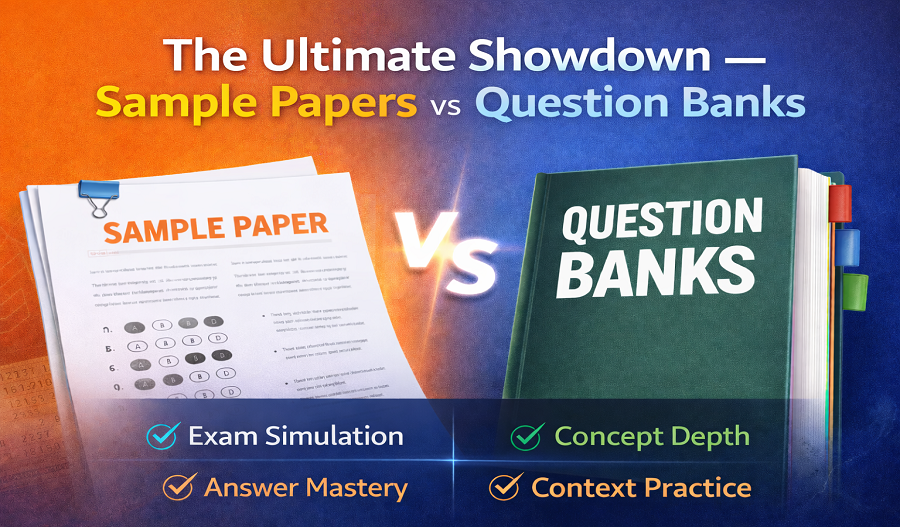
Sample Papers vs Question Banks
Which is the Real Game-Changer for CBSE 2026?
The debate between Sample Papers and Question Banks has confused CBSE aspirants for years. Students oscillate between these tools, unclear about which to prioritize, when to use each, and how to maximize their strategic value. The truth? This is not an either-or question—it's a question of strategic sequencing and purposeful integration.
This comprehensive guide deconstructs both tools through a data-driven, phase-based framework that eliminates confusion and provides actionable clarity. Your success in CBSE 2026 depends not on choosing one tool over the other, but on understanding exactly how each serves distinct, non-overlapping purposes in your preparation architecture.
Understanding the Fundamental Distinction
Before diving into strategic frameworks, we must establish definitional clarity. Sample Papers and Question Banks are not interchangeable resources with overlapping purposes—they serve fundamentally different roles in the preparation ecosystem.
Question Banks: The Depth Tool
Question Banks are comprehensive collections organized chapter-wise, covering every possible question type within each topic. They provide:
- Conceptual depth: Multiple variations of the same concept
- Targeted practice: Focused work on specific weak areas
- Step-wise learning: Progressive difficulty within each chapter
- Partial marking preparation: Learning to structure answers for maximum points
Sample Papers: The Simulation Tool
Sample Papers are full-length examinations designed to mirror the actual CBSE Board format. They provide:
- Exam stamina building: Training for sustained 3-hour concentration
- Time management practice: Developing pacing strategies
- Integrated thinking: Connecting concepts across chapters
- Diagnostic insights: Revealing execution errors vs. knowledge gaps
The Four-Phase Marathon Sprint Strategy
CBSE 2026 preparation is neither a leisurely marathon nor a frantic sprint—it's a marathon sprint. This framework divides your preparation into four distinct phases, each with specific tool priorities and strategic objectives.
Phase I: Consolidation (Months 1-4)
Primary Tool: Question Banks (90% usage)
This is your foundation-building phase. The objective is not breadth but depth—mastering the fundamental concepts that will serve as your competitive infrastructure.
Strategic Focus:
- Chapter-wise systematic coverage using Question Banks
- Master step-wise logic for partial marks on complex questions
- Build your "library filing system" through organized knowledge categorization
- Create flashcards for difficult questions using the Leitner System
- Focus on understanding WHY answers are correct, not just WHAT the answer is
Sample Paper Usage:
Minimal (10%). Attempt 1-2 papers purely for diagnostic purposes—to identify which chapters need the most Question Bank work. Don't expect high scores; these are reconnaissance missions.
Phase II: Application (Months 5-7)
Balanced Integration (50-50 split)
Now you begin connecting isolated chapter knowledge into integrated understanding. This is where Question Banks and Sample Papers work in tandem.
Strategic Protocol:
- Solve Sample Papers weekly to identify cross-chapter weak points
- Return to Question Banks for targeted remediation of revealed weaknesses
- Practice answer architecture: context lines, step-wise solutions, concluding themes
- Build time management awareness without obsessing over speed
- Start training your brain's "retrieval practice" under simulated pressure
Phase III: Diagnostic Refinement (Months 8-10)
Primary Tool: Sample Papers (70% usage)
Sample Papers now dominate your preparation. The goal shifts from knowledge acquisition to execution precision and stamina development.
Critical Activities:
- Solve 2-3 full-length Sample Papers per subject under strict exam conditions
- Analyze not just wrong answers but patterns of errors (conceptual vs. careless)
- Build sustained 3-hour concentration through repeated full-paper practice
- Perfect your pacing strategy for different question types
- Use Question Banks (30%) only for targeted weakness elimination
Phase IV: Final Polish & Tapering (Final Month)
Sample Papers + Mistake Review (80-20 split)
The final month is about consolidation, confidence-building, and preventing anxiety spikes from new material.
Tapering Phase Protocol:
- Complete remaining Sample Papers with rigorous time discipline
- Review your Mistake Notebook from Question Bank work
- Light revision of Leitner System flashcards (Box 1 only)
- Final 5 days: NO new difficult topics—only light formula review and mental visualization
- Ensure 8 hours of sleep for peak cognitive performance
Strategic Integration Frameworks
1. The 70-20-10 Revision Rule
This framework governs how you allocate both Question Bank and Sample Paper time across your knowledge landscape:
70% - Strong Areas (Question Banks):
Use Question Banks to deepen mastery in topics where you're already competent. These are your scoring territories—make them impregnable. The goal is achieving near-perfect accuracy under time pressure, not just correct answers in unlimited time.
20% - Weak Areas (Question Banks):
Systematically strengthen 2-3 persistently problematic topics. Question Banks allow focused, chapter-specific remediation without the overwhelming pressure of full papers. Convert complete blind spots into areas of moderate competence.
10% - Error Identification (Sample Papers):
Use Sample Papers to diagnose whether you're still making careless calculation errors, misinterpreting symbols, or suffering from time-pressure-induced mistakes. This 10% reveals execution problems that Question Banks alone cannot expose.
2. The Library Catalogue Metaphor
Your brain is a library. Exam performance depends not just on what books (knowledge) you possess, but on how efficiently you can locate them under the pressure of a 3-hour time limit.
Question Banks: The Filing System
Question Banks organize your mental library. They create clear categories, establish logical connections between concepts, and ensure information is stored with proper tags for future retrieval. When you work through a Question Bank systematically:
- Facts get filed in the correct mental "section"
- Similar concepts are stored together with distinguishing markers
- You build a coherent organizational structure, not a chaotic pile of information
Sample Papers: The Retrieval Practice
Sample Papers train your brain to FIND filed information quickly under stress. The 3-hour clock creates the pressure environment where retrieval speed matters. You discover:
- Which mental files are easily accessible vs. deeply buried
- Where your filing system has organizational gaps
- How stress affects your brain's search algorithm
- Which retrieval pathways need strengthening
The mistake most students make: they build a massive library (extensive Question Bank work) but never practice navigating it under time pressure (insufficient Sample Papers). Or conversely, they practice retrieval (Sample Papers) from a poorly organized library (inadequate Question Bank foundation). Both tools must work in concert.
3. Answer Architecture Mastery
CBSE Board exams reward not just correct answers, but well-structured, examiner-friendly presentation. Both tools teach different aspects of answer architecture:
From Question Banks: Learn Step-Wise Logic
Question Banks teach you how to structure answers for partial marks. Study the solutions provided and note:
- How complex problems are broken into numbered steps
- Where diagrams should be inserted and how they should be labeled
- Which intermediate calculations deserve their own line
- How to show your reasoning process clearly
From Sample Papers: Practice Context & Conclusion
Sample Papers train you to add the professional touches that distinguish high scores from average ones:
- Context line: Begin answers by restating the question or establishing the framework
- Concluding theme: End with a summary statement or thematic message
- Time-appropriate depth: Learn how much detail fits within available minutes
- Examiner perspective: Write for someone reading 200 papers, not for yourself
4. The Leitner System Integration
As you work through Question Banks, you'll encounter questions that resist mastery—problems you get wrong repeatedly or concepts that feel slippery and unreliable. These are perfect candidates for the Leitner System.
Converting Question Bank Struggles into Spaced Repetition Assets
Implementation Protocol:
- Identify resistant questions: Any Question Bank problem you get wrong twice
- Create flashcards: Front side = the question; Back side = key concept/formula needed
- Establish review boxes:
- Box 1: Daily review
- Box 2: Every 3 days
- Box 3: Weekly review
- Promotion system: Two consecutive correct recalls = move to next box
- Demotion on failure: Any error = back to Box 1
This system ensures that difficult Question Bank concepts don't just get "reviewed once" and forgotten—they enter a scientifically-grounded cycle that moves them into long-term, pressure-proof memory.
5. Gamifying the Question Bank
Question Bank work can become monotonous, leading to passive completion rather than active learning. Gamification transforms drilling into engaging cognitive challenges.
Strategic Gamification Methods
Speed Challenges:
Set a timer and challenge yourself to complete a 10-question set from the Question Bank in decreasing time. Track your speed improvement while maintaining accuracy. This builds the rapid execution needed for Sample Papers.
Accuracy Streaks:
Aim for consecutive correct answers without breaks. A streak of 15-20 correct responses creates momentum and confidence. One mistake resets the streak, maintaining high attention.
Quality Scoring:
Rate each of your answers on presentation quality (1-5 scale). Aim to improve your average "presentation score" over time, which directly improves writing fluency—critical for time management in Sample Papers.
These gamification strategies prevent burnout while simultaneously building the execution speed and quality needed for excellent Sample Paper performance.
Advanced Optimization Techniques
The Sleep Timer Retrieval Hack
Your brain consolidates memories during sleep. Strategic audio exposure before sleep can enhance retention of Question Bank concepts.
Pre-Sleep Audio Protocol
Implementation:
- Create or find NCERT-based audio summaries of key concepts
- Listen for 20-30 minutes before sleep (not while in bed—during pre-bed routine)
- Focus on topics you studied in Question Banks that day
- Keep volume low and delivery calm (high energy disrupts sleep onset)
- Stop listening 15 minutes before actually getting into bed
This technique keeps "Question Bank logic" circulating in your brain during the critical consolidation window. Your sleeping brain continues processing and organizing the information you filed during the day.
Deadline Visualization
One of the most common preparation failures is losing track of time, leading to last-minute panic when students realize they haven't transitioned from Question Banks to adequate Sample Paper practice.
Strategic Milestone Setting
Set clear, non-negotiable deadlines for phase transitions:
- Milestone 1: Complete all chapter-wise Question Banks by [specific date]
- Milestone 2: Begin weekly Sample Papers by [specific date]
- Milestone 3: Complete 2-3 Sample Papers per subject by [specific date]
- Milestone 4: Enter Tapering Phase [5 days before exam]
Use countdown apps or calendar alerts to maintain awareness. Visual daily reminders prevent the comfortable drift that keeps students in the Question Bank phase too long, leaving insufficient time for Sample Paper mastery.
Frequently Asked Questions
Question Banks build the library. Sample Papers teach you to navigate it under pressure.
Master both strategically. Execute with precision. Trust the phased approach.

.png)