How Early Career Planning Helps Academic Success
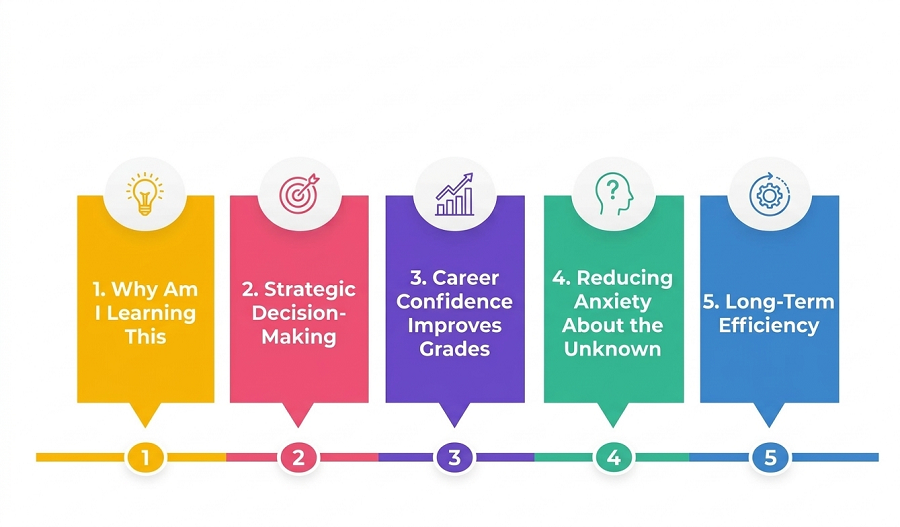
How Early Career Planning Helps Academic Success
Why thinking about your future today makes studying easier tomorrow
Imagine trying to navigate a city you have never visited without a map, GPS, or even a destination in mind. You would wander aimlessly, waste time, and probably end up frustrated. Now imagine having a clear destination and a flexible route to get there. Suddenly, every turn makes sense. Every decision has purpose.
This is exactly what early career planning does for students. It does not mean locking yourself into one rigid path at age 13. It means having a sense of direction that makes your daily schoolwork feel meaningful rather than pointless.
The result? Better grades. Less stress. More confidence. And a smoother journey toward whatever future you choose.
1. Motivation Through Purpose: Why Am I Learning This?
"Why do I need to learn algebra? When will I ever use this in real life?"
Every student has asked this question. And the truth is, without a sense of purpose, it is hard to stay motivated. When you cannot see how today's homework connects to tomorrow's goals, studying feels like a chore.
Early career planning changes this completely. When you have even a rough idea of what interests you - whether it is medicine, technology, business, art, or something else - you start to see connections everywhere.
Neha, a 9th grader, was struggling with motivation in science class. Then she attended a career talk where a veterinarian explained how biology helps her diagnose sick animals and chemistry helps her understand medications. Suddenly, Neha's science homework had meaning. She was not just memorizing the digestive system - she was learning how to help animals someday.
How Purpose Reduces Procrastination:
- When you know why you are studying, it is easier to start
- Long-term goals make short-term effort feel worthwhile
- You shift from "I have to study" to "I want to learn this because..."
- Even boring topics become tolerable when you see their future value
This does not mean you need to know your exact career at age 14. Even broad interests help. Knowing you like working with people makes psychology class more interesting. Knowing you enjoy problem-solving makes mathematics feel less abstract.
2. Strategic Decision-Making: Choosing Wisely, Early
Middle school and high school are full of choices. Which elective should you take? Should you join the debate club or the coding club? Should you focus on science or humanities in Class 11?
These choices might seem small at the time, but they add up. And some of them can accidentally close doors you did not even know existed.
The Importance of Early Awareness
Students who start thinking about career possibilities as early as middle school make more informed decisions about:
- Which subjects to prioritize
- Which extracurricular activities to join
- Which skills to develop outside the classroom
- Which stream to choose after Class 10
These decisions create a foundation that makes future opportunities more accessible.
Rohan wanted to become a pilot. But he chose the Commerce stream in Class 11 without researching requirements. Later, he discovered that pilots need Physics and Mathematics - subjects he had dropped. He had to spend an extra year taking bridge courses to become eligible for flying school. Early planning could have saved him that time and money.
Strategic Benefits of Early Planning:
Subject Selection
Choose subjects that keep future options open rather than accidentally limiting yourself
Skill Building
Start developing relevant skills early - coding, public speaking, writing, design - whatever aligns with your interests
Extracurricular Focus
Join clubs and activities that genuinely interest you and build relevant experience
Informed Exploration
Try different things while knowing what skills or experiences might be useful later
The key word here is awareness, not commitment. You are not locking yourself in. You are keeping options open through informed choices.
3. The Link to Performance: Career Confidence Improves Grades
Here is something most people do not realize: students who have career goals tend to get better grades.
This is not a coincidence. Research shows a strong connection between career confidence and academic performance. The link comes through something called "effort regulation" - the ability to keep working even when tasks are difficult or boring.
Students with clear career direction show measurably higher GPAs and exam success rates
How Career Planning Improves Academic Performance:
Effort Regulation
When you have a goal, you develop the discipline to push through difficult subjects. You do not give up on challenging homework because you see it as a step toward something you care about.
Better Time Management
Students with goals prioritize better. They know which subjects need more attention. They balance their time between schoolwork, extracurriculars, and skill-building more effectively.
Increased Engagement
When you care about where you are going, you pay more attention in class. You ask more questions. You connect concepts across subjects. This deeper engagement naturally leads to better understanding and retention.
Priya knew she wanted to study computer science in college. This awareness changed how she approached her Class 11 Mathematics. Instead of just solving problems mechanically, she tried to understand the logic because she knew programming requires logical thinking. Her math scores improved from 65% to 88% - not because she worked harder, but because she worked with purpose.
Resilience Through Setbacks
Everyone faces academic challenges. But students with career goals bounce back faster from poor grades or difficult topics because they see setbacks as temporary obstacles, not permanent failures.
4. Psychological Well-Being: Reducing Anxiety About the Unknown
One of the biggest sources of stress for students is uncertainty about the future.
"What will I do after school? What if I make the wrong choice? What if I fail? What if I do not know what I want?"
These questions create constant background anxiety. Early career planning does not eliminate uncertainty - the future is always uncertain - but it dramatically reduces anxiety by giving you a sense of control.
From Passenger to Architect
Without planning, you feel like a passenger in your own life - things happen to you, choices are made for you by circumstances or other people's advice, and you react rather than direct.
With planning, you become the architect of your future. You make active choices. You explore options. You experiment and learn. Even if plans change, you are the one making decisions, not just accepting whatever comes.
Psychological Benefits of Early Planning:
Reduced Fear of the Unknown
When you have researched career paths, talked to professionals, and explored options, the future feels less scary. You know there are multiple paths. You know what steps to take. The unknown becomes known.
Increased Self-Confidence
Making informed decisions builds confidence. Every time you choose a subject, join a club, or develop a skill based on your interests and goals, you reinforce that you are capable of shaping your future.
Better Stress Management
Students with plans report lower stress levels because they feel prepared. They are not scrambling at the last minute to figure out which college to apply to or which stream to choose. They have thought about it. They have options.
Sense of Agency
Perhaps most importantly, career planning gives you a sense of agency - the feeling that your actions matter, that your choices shape outcomes, that you have power over your life direction.
Arjun, a Class 10 student, was anxious about stream selection. His parents wanted him to take Science, but he was interested in Business and Economics. After career counseling, he researched both paths, talked to professionals in different fields, and realized Commerce with Math keeps multiple doors open. Making an informed choice reduced his anxiety because he understood his options and felt in control of the decision.
5. Long-Term Efficiency: Graduating On Time, Reducing Debt
Early career planning has very practical, tangible benefits that save time and money in the long run.
Graduating On Time
Students who choose their college major with awareness and intention are far more likely to stick with it and graduate on time. Those who choose randomly or based solely on parental pressure often realize mid-college that they picked the wrong field and either switch majors (adding extra years) or struggle through something they hate.
Informed major selection prevents costly changes and delays in graduation
Reducing Student Debt
Extra years in college mean extra tuition fees, extra hostel costs, and delayed earning. Students who graduate on time save lakhs of rupees and start earning sooner.
Additionally, students with clear goals make better decisions about which college to attend and which programs to choose based on return on investment, not just prestige or parental expectations.
Avoiding Dead Ends
Some career paths require specific qualifications that must be obtained at specific times. Early planning helps you avoid accidentally disqualifying yourself from careers you might have loved.
For example, wanting to become a pilot but not taking Physics and Math in Class 11. Or wanting to study law but missing the CLAT application deadline because you did not know about it.
The Compounding Effect of Smart Decisions
Every informed decision you make early compounds over time:
- Choosing the right subjects - Getting into the right college program
- Building relevant skills - Getting internships and opportunities
- Graduating on time - Starting your career earlier
- Choosing a field you enjoy - Long-term satisfaction and success
Small advantages accumulate. Early planning creates those advantages.
Career Readiness
Students who plan early often graduate more prepared for the job market. They have relevant internships, practical skills, and a clearer understanding of what employers want because they started thinking about this earlier.
Maya knew from Class 9 that she wanted to work in environmental sustainability. She chose Science in Class 11, pursued Environmental Science in college, did internships with NGOs during summer breaks, and had a job offer before graduation. Her classmate Sanjay chose Environmental Science randomly, realized late he was not passionate about it, switched to an MBA program, adding two more years of education and significant expense.
Final Thoughts: A Roadmap, Not a Cage
The most important thing to understand about career planning is this: it is a flexible roadmap, not a fixed destination.
Planning does not mean deciding at age 13 that you will be a doctor and never considering anything else. It does not mean choosing one rigid path and refusing to deviate.
Instead, it means:
- Exploring your interests and strengths
- Learning about different career possibilities
- Making informed choices about subjects, activities, and skills
- Staying open to new opportunities while having a general direction
- Adjusting your path as you learn and grow
Many successful people changed careers multiple times. But they succeeded because they made informed choices at each stage, not random ones.
Think of early career planning like planning a road trip. You choose a general destination and a route, but you are free to take detours, explore interesting places along the way, and even change your final destination if you discover somewhere better. The planning does not restrict you - it empowers you to make the journey deliberately rather than drifting wherever the road happens to lead.
Start early. Explore widely. Plan flexibly. And watch how having direction transforms not just your grades, but your entire academic experience.
Your future is being built right now, one choice at a time.
Make those choices with awareness. Make them with intention. Make them yours.
The best time to start planning was yesterday. The second best time is today. ?

.png)