How to Improve Study Efficiency with Proven Methods
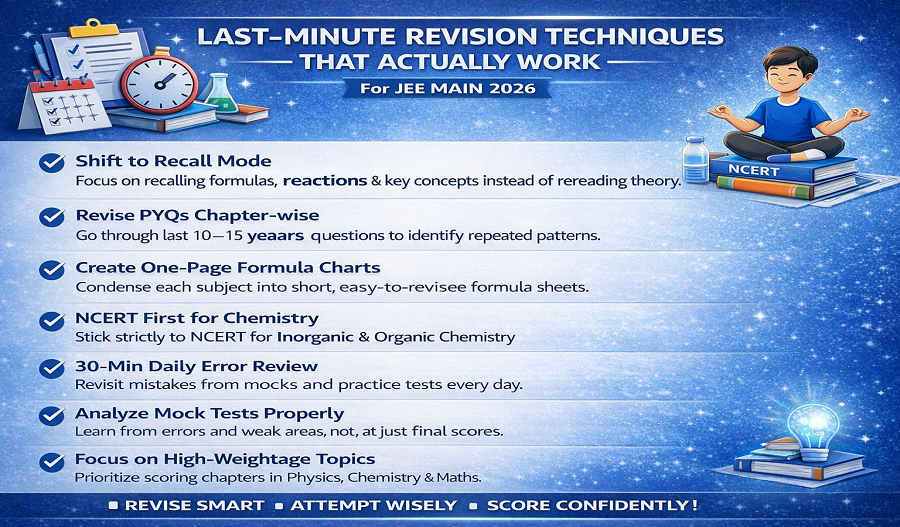
Revision Techniques That Actually Work Now
(For JEE Main 2026 – Last-Month Smart Revision Guide)
With JEE Main 2026 just weeks away, this is not the time to start new books or learn fresh concepts from scratch. The goal now is retention, accuracy, and confidence. Smart revision in the final phase can easily boost your score by 30–50 marks if done correctly.
Below are proven revision techniques that work now, not generic advice.
1️⃣ Shift from Learning Mode to Recall Mode
In the final weeks, reading theory again and again creates false confidence. Instead:
- Close the book and recall formulas, reactions, and concepts
- Write them down from memory
- Check gaps immediately
⇒ If you can recall, you can solve.
2️⃣ Use PYQ's as Revision Tools (Not Practice)
Previous Year Questions are your best revision material now.
- Revise last 10–15 years PYQs chapter-wise
- Focus on patterns & repeated concepts
- Note common mistakes you’ve already made
⇒ Don’t time yourself here—understand why the answer works.
Also attempt: JEE Main 2026 Online Test Series.
3️⃣ One-Page Formula & Concept Sheets
Create or use ultra-short notes:
- Physics: formulas + units + common traps
- Chemistry: reactions, NCERT lines, exceptions
- Maths: formulas + standard results
⏱️ Revise these daily in 30–45 minutes.
These sheets should be your last-week companion.
4️⃣ The 30-Minute Error Revision Rule
Your mistakes are your biggest score boosters.
Every day:
-
Spend 30 minutes revising:
-
- Wrong questions from mocks
- Silly calculation errors
- Conceptual misunderstandings
❌ Don’t ignore mistakes just because you “understand now.”
5️⃣ NCERT-First Revision for Chemistry
Chemistry is the easiest marks booster in JEE Main.
- Read NCERT line by line for Inorganic
- Revise examples & tables for Organic
- Memorize formulas & trends for Physical
⇒ Most Chemistry questions are direct or NCERT-inspired.
6️⃣ Subject-Wise Smart Revision Strategy
♦ Physics
- Revise formulas + derivations logic
- Focus on Modern Physics, Current Electricity, Optics
- Solve numericals you’ve already done (confidence boost)
♦ Chemistry
- Inorganic → NCERT only
- Organic → Named reactions & mechanisms
- Physical → Formula + unit clarity
♦ Mathematics
- Revise scoring chapters first
- Practice standard question types
- Avoid lengthy calculations close to exam
7️⃣ Limit Mock Tests, Maximize Analysis
Mocks help only when analyzed properly.
- 2–3 mocks per week are enough
- Spend more time analyzing than attempting
- Identify:
-
- Weak chapters
- Time-consuming question types
- Accuracy percentage
⇒ Improvement comes from analysis, not quantity.
JEE Practice Tests - Click Here
8️⃣ Avoid These Revision Mistakes Now
× Starting new reference books
× Watching long theory lectures
× Changing your exam strategy
× Studying randomly without a plan
Stick to what you know and strengthen it.
9️⃣ Daily Revision Blueprint (Final Phase)
A simple structure:
- Morning: Formula & short-note revision
- Afternoon: PYQs or error revision
- Evening: Subject-wise focused revision
- Night: Light recall (no heavy problem-solving)
Consistency matters more than long hours.
? Confidence Is Part of Revision
Revision isn’t only academic—it’s mental.
- Revise what you can do well
- Trust your preparation
- Stay calm and consistent
⇒ A calm mind solves faster and makes fewer mistakes.
Final Words
In the last month before JEE Main 2026, smart revision beats hard revision.
Focus on recall, mistakes, PYQs, and NCERT—and you’ll walk into the exam hall with clarity and confidence.
Revise smart. Attempt wisely. Score confidently.
Ranker's Package for JEE Main 2026 - Click Here

.png)