How to Optimize PYQs for Exam Success
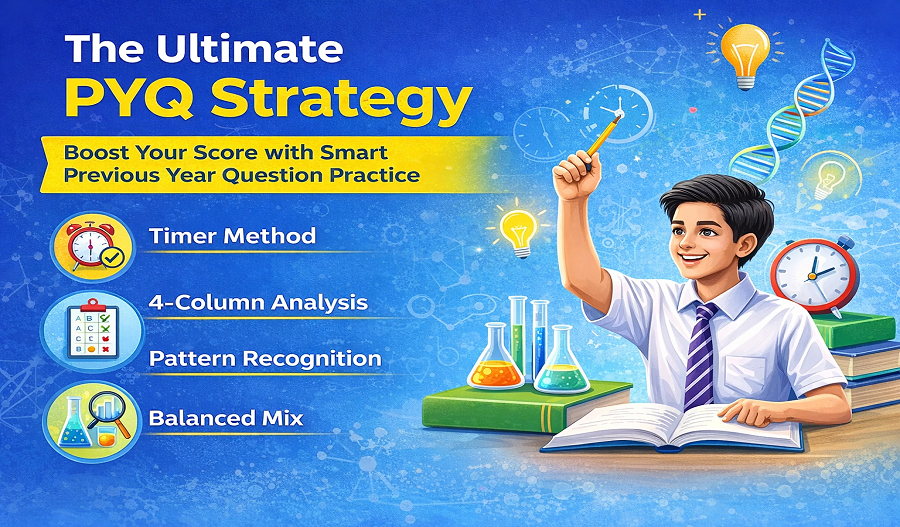
The Ultimate PYQ Strategy
How to Boost Your JEE/NEET 2026 Score in the Final 2 Months
What if I told you that the questions in your JEE/NEET exam are not completely new?
Here is the truth: 60-70% of the concepts tested in your exam have appeared in previous years in some form. The questions might be twisted differently, but the core concepts remain the same.
This means that if you solve Previous Year Questions (PYQs) strategically, you are not just practicing. You are learning the exam's language. You are understanding what NTA loves to ask. You are preparing smarter, not harder.
With only 2 months left for your exam, you do not have time to waste on random practice. You need a focused, efficient strategy. And that strategy starts with PYQs.
But here is the problem: most students solve PYQs wrong. They treat them like any other practice paper. They miss the real value.
This guide will show you exactly how to use PYQs to maximize your score in the final stretch.
The 3 Big Mistakes Students Make with PYQs
Before we talk about what to do, let us talk about what NOT to do. These mistakes cost students 20-30 marks easily.
❌ Mistake #1: Solving Without a Timer
You sit down, open a PYQ paper, and solve it at your own pace. You take breaks. You check your phone. You spend 10 minutes on one difficult question.
Why this is wrong: The real exam is all about time pressure. If you never practice under timed conditions, you will panic on exam day. You will run out of time even if you know all the answers.
❌ Mistake #2: Just Checking Answers Without Understanding "Why"
You solve the paper. You check your answers. "Oh, I got this wrong. The answer is B." Then you move on.
Why this is wrong: You are just collecting marks, not learning. When a similar concept appears with a twist, you will make the same mistake again.
❌ Mistake #3: Only Solving the Most Recent Papers
"I will just solve 2023, 2024, and 2025 papers. Older papers are outdated."
Why this is wrong: NTA repeats concepts every 3-5 years with different twists. A 2019 Physics question might reappear in 2026 with a new scenario. You are missing valuable practice.
Your Strategic Action Plan: The 4-Step PYQ Method
Step 1: The Timer Method (Full Exam Simulation)
When you sit down to solve a PYQ paper, treat it like the real exam. No exceptions.
How to Execute Full Exam Mode
Why this works: Your brain builds stamina. On exam day, 3 hours will feel normal, not exhausting. You will also learn which sections take more time and adjust accordingly.
Step 2: Deep Analysis Using the 4-Column Rule
After solving the paper, spend equal time analyzing it. If you spent 3 hours solving, spend 3 hours analyzing.
Create a simple analysis table for every paper you solve:
| Question No. | Correct/Wrong | Why Wrong? | How to Fix? |
|---|---|---|---|
| Q15 (Physics) | Wrong | Sign convention error in optics | Revise sign rules, solve 10 similar problems |
| Q23 (Chemistry) | Wrong | Forgot to balance the equation | Always check atom count on both sides |
| Q41 (Biology) | Correct (but guessed) | Was not sure about the process | Read NCERT chapter again |
Key Points for Analysis
- Wrong answers: Identify if it was a concept gap, calculation error, or silly mistake
- Correct but guessed: These are as important as wrong answers. You got lucky this time. Fix the concept.
- Time-consuming questions: Note which questions took too long. Practice faster methods.
- Pattern observation: If you keep making the same type of error, that is your weak area
Step 3: Pattern Recognition (Find the "Micro-Themes")
After solving 5-7 PYQ papers, you will start noticing patterns. Some topics appear every single year. Some question types are repeated with small twists.
Your job is to identify these "micro-themes" - the specific concepts that NTA loves to test.
How to Identify High-Yield Topics
- Make a frequency chart: After every PYQ, note which chapters appeared and how many marks
- Track repeating concepts: Example: "Ray optics mirror formula appears in 8 out of 10 years"
- Notice question twists: Same formula, different scenario each year
- Prioritize accordingly: Topics that appear frequently deserve more practice time
Common high-frequency topics:
- JEE Physics: Mechanics (especially rotational motion), Optics, Electrostatics, Current Electricity
- JEE Chemistry: Organic mechanisms, Coordination compounds, Chemical equilibrium, Electrochemistry
- JEE Maths: Calculus (definite integration), Coordinate geometry, Probability, Vectors
- NEET Physics: Optics, Current electricity, Modern physics basics
- NEET Chemistry: Organic reactions, Chemical bonding, Equilibrium
- NEET Biology: Human physiology, Genetics, Ecology, Plant physiology
Step 4: Balancing PYQs with Mock Tests
With 2 months left, you need both PYQs and Mock Tests. But they serve different purposes.
PYQs Are For
- Understanding exam patterns
- Learning what gets asked repeatedly
- Building concept clarity
- Focused topic practice
Mock Tests Are For
- Building exam temperament
- Testing overall preparation
- Improving time management
- Handling new question formats
Recommended Schedule for Final 2 Months
Month 1 (Weeks 1-4):
- Solve 2 PYQ papers per week (year-wise, complete papers)
- Deep analysis: 3 hours per paper
- Take 1 mock test on weekends
- Identify and revise weak topics immediately
Month 2 (Final 4 Weeks):
- Solve 1 PYQ paper per week (your weakest years)
- Take 2-3 mock tests per week
- Focus more on mock tests to build confidence
- Last week: Light revision only, no new PYQs
PYQ's for JEE :- Click Here
PYQ's for NEET :- Click Here
Bonus Topper Tip: Create 1-Pager PYQ Notes
Here is something toppers do that average students miss: they create "1-Pager Notes" for every weak topic identified through PYQs.
How it works: After analyzing your PYQs, you will know your weak areas. For each weak topic, create a single-page summary.
What Goes in a 1-Pager Note
- Key formulas - Write them in a box at the top
- Common mistakes - What errors did you make in PYQs?
- Quick tricks - Any shortcuts you discovered
- Example question - One representative PYQ with solution
- Important points - Concepts you always forget
Why this is powerful: In the final week before your exam, you do not have time to revise entire chapters. But you can quickly go through 15-20 one-pagers and cover all your weak areas.
Your PYQ Game Plan: Start Today
PYQs are not just practice papers. They are your roadmap to the exam. They show you what matters, what repeats, and where you are weak.
But remember: solving PYQs randomly will not help you. You need a system.
Follow this 4-step method:
- Solve under full exam mode with a timer
- Analyze deeply using the 4-column rule
- Identify patterns and high-frequency topics
- Balance PYQs with mock tests strategically
And do not forget the bonus tip: Create those 1-pager notes for your weak areas. They will save you in the final days.
You have 2 months. That is enough time if you use it wisely. Start with your first PYQ paper today. Not tomorrow. Today.

.png)