JEE Advanced 2026: Smart Preparation Strategy for Top Rank
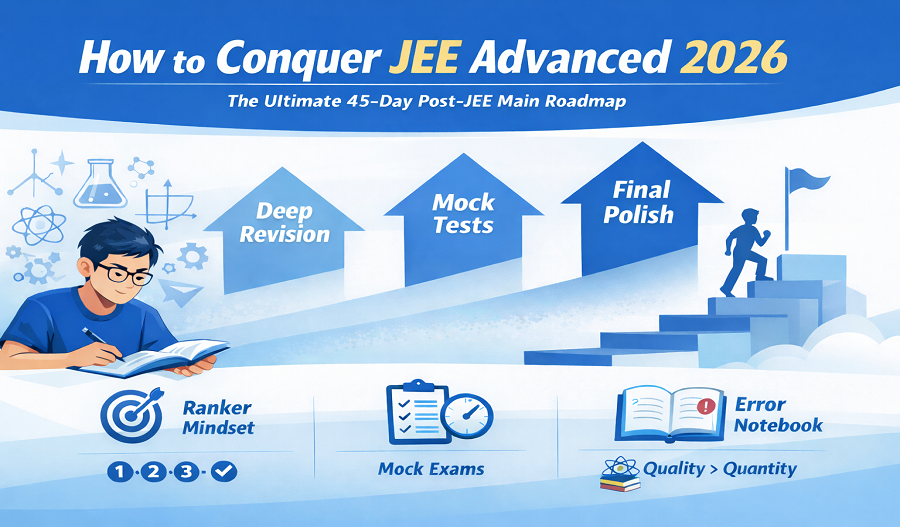
Congratulations on completing JEE Main! Now comes the real challenge.
JEE Advanced is not just a harder version of JEE Main. It is a completely different exam that tests a completely different skill set.
You have 45 days to make the shift. This roadmap will show you exactly how.
1. The Critical Mindset Shift
The first thing you need to understand is that JEE Main and JEE Advanced test different abilities.
The Ranker Mindset
In the next 45 days, you are not a student anymore. You are a ranker in training. This means you stop asking "What is this formula?" and start asking "Why does this work? When do I apply it? How does it connect to other concepts?"
JEE Main rewarded those who could solve 75 questions quickly. JEE Advanced rewards those who can solve 54 questions correctly - even if it takes time.
2. The 45-Day Strategic Phase Breakdown
Your 45-Day Timeline
Goal: Rebuild concepts from foundation + Fix weak areas from JEE Main
- Focus on high-weightage topics for each subject
- Solve 20-30 high-quality problems per subject daily (not bulk easy problems)
- Analyze every mistake from JEE Main - identify concept gaps
- Revise theory deeply - understand the "why" behind formulas
- Create short notes and formula sheets for quick revision
Goal: Build stamina for 6-hour exam day + Develop attempt strategy
- Take 6-8 full-length mock tests (both Paper 1 and Paper 2)
- Align your body clock with exam schedule (Paper 1: 9 AM-12 PM, Paper 2: 2:30 PM-5:30 PM)
- Practice sitting for 6 continuous hours with only a 2-hour break
- Spend 2-3 hours analyzing each mock test
- Track your performance - accuracy, speed, subject-wise scores
Goal: Peak readiness + Mental calmness
- Stop learning new topics - only revise what you know
- Review your Error Notebook from all mocks
- Memorize inorganic chemistry exceptions and reactions
- Solve last 3 years of JEE Advanced PYQs to understand current trends
- Light revision of formulas and short notes
- Sleep 8 hours daily - mental clarity is crucial
Quality Over Quantity
Solving 20 high-quality, multi-concept problems is far superior to solving 80 simple, single-concept problems. JEE Advanced rewards depth, not speed.
3. Subject-Specific Deep Dives
Each subject in JEE Advanced requires a specific approach. Here is your subject-wise strategy:
4. Key Exam Techniques & Time Management
The 3-Round Strategy
In the actual exam, you cannot attempt questions in order. You need a smart strategy:
Round 1 (First 60 minutes): Solve all Easy questions across all three subjects. These are questions you can solve in 2-3 minutes with confidence. Build your base score and confidence.
Round 2 (Next 90 minutes): Tackle Moderate questions. These need thinking and calculation but are solvable. This is where your rank is decided.
Round 3 (Final 30 minutes): Attempt Tough/Time-consuming questions. Solve what you can. Skip what you cannot. Review your answers.
The 2-Minute Rule
If a question is not showing you a clear path to solution in 2 minutes, mark it and move on.
In JEE Advanced, spending 10 minutes on one difficult question means missing 3-4 easier questions. The exam rewards smart attempt strategy, not stubbornness.
Important: This does not mean giving up. It means strategic prioritization. Come back to tough questions in Round 3 if time permits.
Exam Day Schedule (May 17, 2026)
3 hours | Physics, Chemistry, Mathematics | 54 questions total
2.5 hours | Lunch + Rest (Do NOT discuss Paper 1 with anyone)
3 hours | Physics, Chemistry, Mathematics | 54 questions total
Total Exam Duration: 6 hours of intense mental work. This is why building stamina through full-length mocks is critical.
5. Critical Mistakes to Avoid
❌ Mistake 1: Treating Advanced Like a Faster Version of Main
JEE Advanced is not about speed. It is about accuracy and depth. If you approach it with JEE Main mindset (solve fast, move on), you will make costly mistakes. Slow down. Think deeply. Solve correctly.
❌ Mistake 2: Ignoring Negative Marking
JEE Advanced has partial negative marking. Only attempt a question if you are 70-80% sure. Blind guessing will destroy your score. It is better to leave 5 questions unattempted than to guess 10 questions and get 7 wrong.
❌ Mistake 3: Neglecting Health and Sleep
Mental clarity is vital for a 6-hour test. Sleep 8 hours daily. Eat properly. Exercise for 30 minutes. Do not sacrifice health thinking "I will rest after the exam." A tired brain cannot perform analytical reasoning.
❌ Mistake 4: Studying New Topics in Final Week
Days 36-45 are for refinement, not learning. Starting a new chapter in the final week creates confusion and panic. Stick to revision of what you already know.
6. Daily Study Plan Example (Phase 1)
Here is what a typical day should look like during Phase 1 (Days 1-20):
Time Management Tip
This is a sample schedule. Adjust based on your peak concentration hours. Some students study better at night. Some in the morning. Find what works for you and stick to it.
7. The Power of the Error Notebook
This is the single most important tool in your 45-day preparation.
What is an Error Notebook?
A dedicated notebook where you write down every mistake you make - from mock tests, PYQ practice, or daily problem-solving.
What to write:
- Question number and topic
- Why you got it wrong (concept gap? silly mistake? time pressure?)
- The correct solution in your own words
- The key concept or formula to remember
When to review:
- Before every mock test
- Daily for 30 minutes
- Intensive review in Phase 3 (Days 36-45)
The Error Notebook Advantage
Students who maintain and review an Error Notebook typically score 30-50 marks higher than those who don't. Why? Because they stop repeating the same mistakes. They learn from errors instead of just moving on.
Your 45-Day Journey Starts Now
JEE Advanced 2026 is on May 17. You have 45 days to transform from a JEE Main qualifier to a JEE Advanced ranker.
This is not going to be easy. The problems will be harder. The concepts will be deeper. The exam will be longer and more demanding than anything you have faced.
But you can do this.
Follow the 3-phase roadmap. Focus on high-weightage topics. Solve quality problems. Take full-length mocks. Build your Error Notebook. Master the 3-Round strategy.
Most importantly: shift your mindset from student to ranker. Think deeply. Solve analytically. Stay consistent.
45 days. That is all you have. Make every day count.

.png)