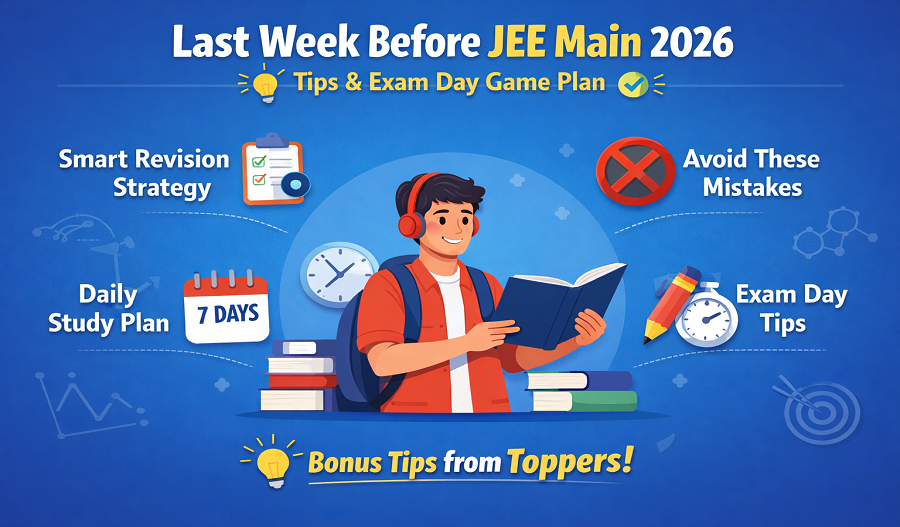
Seven days. That is all you have left before one of the most important exams of your life.
Your mind is racing. You are asking yourself: "Did I cover everything? Should I start new topics? What if I forget everything on exam day?"
Take a deep breath. The last week before JEE Main is not about learning everything - it is about consolidating what you already know and executing a smart game plan.
What you do in these final seven days can make or break your JEE Main 2026 score. Not because you will learn massive amounts of new material, but because you will sharpen what you have already studied, build exam temperament, and enter the hall with confidence instead of panic.
This blog gives you a complete, actionable strategy for the last week - including a detailed exam day game plan that toppers use.
Why the Last Week is Crucial for JEE Main
The last week is not about cramming. It is about peak performance preparation.
Here is what makes this week different:
- Retention Window: What you revise in the last 5-7 days stays freshest in your memory during the exam
- Exam Temperament: Taking mocks now builds the mental stamina needed to sit through a 3-hour high-pressure exam
- Strategic Gaps: This is your last chance to identify and fix weak areas that could cost you marks
- Confidence Building: Solid revision in the final week gives you the psychological edge to perform under pressure
Remember This
Students who panic and try to learn new chapters in the last week often score lower than those who calmly revise what they know. Focus on consolidation, not exploration.
Smart Revision Strategy for the Final 7 Days
Subject-Wise Strategy
Physics
Focus: Formula-based chapters and numerical practice
- Revise all formulas - write them down in one place
- High-weightage: Mechanics (especially Rotational Motion), Current Electricity, Optics, Modern Physics
- Practice 20-25 previous year numericals daily
- Do NOT attempt theory-heavy chapters now (Semiconductors, Communication)
Chemistry
Focus: Quick revision + Inorganic memory work
- Inorganic: Revise NCERT line-by-line. This is pure scoring if you remember
- Organic: Name reactions list, mechanisms for 10 important reactions
- Physical: Formulas + numerical practice (Mole Concept, Equilibrium, Electrochemistry)
- Spend 40% time on Inorganic - highest ROI in last week
Mathematics
Focus: Formula revision + standard problem types
- High-weightage: Calculus (Integration, Differential Equations), Coordinate Geometry, Algebra
- Make a formula sheet covering all chapters
- Practice standard JEE problem types - not ultra-difficult Olympiad-level questions
- Focus on speed - can you solve a Limits question in under 90 seconds?
Mock Tests & Analysis
Take one full-length mock test every alternate day in the last week. Not daily - alternate days.
Why? Because analysis is more important than taking tests. After every mock:
- Spend 2 hours analyzing every wrong answer
- Categorize mistakes: Silly errors, concept gaps, time management
- Revise topics where you made mistakes
- Track your accuracy and speed trends
Golden Rule for Mock Tests
A mock test without analysis is a waste of 3 hours. The learning happens in the 2-hour review, not the 3-hour test.
Things to Avoid in the Last Week
❌ DO NOT Start New Topics
If you have not studied Waves by now, do not start it in the last week. You will not master it, and you will create anxiety. Skip it and focus on strengthening what you know.
❌ DO NOT Over-Study
Studying 14 hours a day in the last week leads to burnout, not better scores. Your brain needs rest to consolidate information. Stick to 8-9 focused hours maximum.
❌ DO NOT Ignore Your Health
Sleep 7-8 hours. Eat proper meals. Do light exercise. Falling sick on exam day because you neglected health is not worth it.
❌ DO NOT Panic or Compare
Your friend might have completed the syllabus three times. Good for them. Focus on your preparation. Comparison creates anxiety, which destroys performance.
Daily Plan for the Last 7 Days
Morning: Physics revision (formulas + 20 PYQs)
Afternoon: Chemistry Inorganic NCERT reading
Evening: Maths formula sheet creation + practice
Night: Light revision, early sleep
Full-length Mock Test in the morning (same time as actual JEE)
Afternoon + Evening: Detailed analysis and mistake correction
Morning: Chemistry revision (Organic reactions + Physical formulas)
Afternoon: Maths practice (high-weightage chapters)
Evening: Physics numericals + doubt clearing
Night: Quick formula revision across all subjects
Second Mock Test - Focus on attempt strategy
Afternoon: Analysis + fix weak areas identified
Morning: Light formula revision only
Afternoon: Relax - watch a movie, take a walk
Evening: Pack your bag (admit card, ID, pens, water)
Night: Sleep early (by 10 PM) - this is non-negotiable
Exam Day Strategy (Very Important)
Before Leaving Home
Check Your Bag
Admit card, ID proof (Aadhar/passport), transparent water bottle, simple analog watch, 2-3 blue/black pens. Nothing else.
Eat Light
Heavy breakfast makes you sleepy. Eat something familiar and light. Avoid experimenting with new foods.
Reach Early
Aim to reach the center 45 minutes before reporting time. Traffic, long queues, or technical issues can happen. Buffer time = peace of mind.
Inside the Exam Hall
First 5 Minutes
Do NOT jump into solving. Spend the first 3-5 minutes scanning all questions. Identify easy, moderate, and difficult ones. This prevents panic later.
Start with Your Strongest Subject
Build confidence early. If you are strong in Chemistry, start there. Get 20-25 questions right quickly to set a positive momentum.
Time Management
Target: 60 minutes per subject (Physics, Chemistry, Maths). Set mental checkpoints: "By 1 hour, I should finish Chemistry."
Attempt Strategy
The 30-50-20 Rule:
- First Pass (30 min): Solve all questions you know instantly - the "easy" ones. Build your base score.
- Second Pass (50 min): Tackle moderate questions that need thinking but are solvable.
- Third Pass (20 min): Attempt difficult questions with educated guesses. Review flagged questions.
Critical: Know When to Skip
If you are stuck on a question for more than 2 minutes, mark it and move on. A question you cannot solve in 2 minutes will not magically become clear in 5 minutes. Come back later if time permits.
Handling Stress During the Exam
- If you are panicking: Close your eyes, take 3 deep breaths, remind yourself "I have prepared well"
- If a section feels very hard: It is hard for everyone, not just you. Stay calm and do your best
- If you make a silly mistake: Do not dwell on it. Accept it and move forward. You cannot change the past, only what you do next
Bonus Tips from Toppers
"I always started with Chemistry because it built my confidence fast. 25 questions in 50 minutes, then Physics, then Maths. This order worked for me." - JEE Main AIR 150
"In the last week, I did not touch new topics. I just revised my formula sheets 5 times and took 4 mocks. That is it. Simple strategy, great results." - JEE Main 99.8 percentile
"My biggest mistake in Attempt 1 was spending 10 minutes on 2 difficult questions and rushing through easy ones. In Attempt 2, I skipped hard questions immediately and scored 30 marks more." - JEE Main 99.5 percentile
Common Topper Strategies:
- Sleep 8 hours the night before - non-negotiable
- Do not discuss paper immediately after the exam - it only creates doubt
- Focus on accuracy over attempting everything - 70 correct is better than 85 with 20 wrong
- Trust your preparation - second-guessing wastes time
Final Motivation
You have worked for months - some of you for years - for this moment. The last week is not about cramming everything you missed. It is about sharpening your edge.
Trust the process. Trust your preparation. You know more than you think you do.
Every mark counts, yes. But panicking does not earn you marks - smart execution does.
Remember these three things on exam day:
- Stay calm. Panic clouds judgment.
- Time management is everything. Do not get stuck.
- You do not need a perfect score. You need a smart attempt.

.png)