The Best Time to Initiate Full-Length Mocks
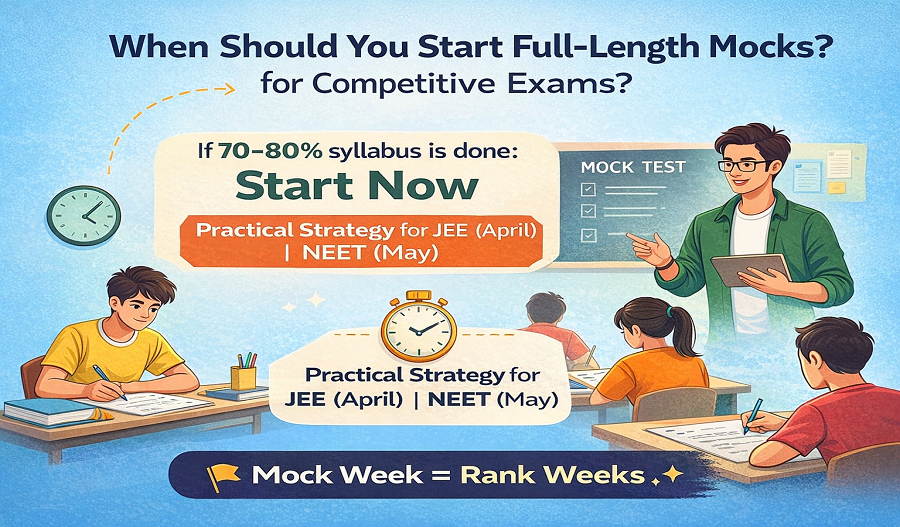
When Should You Start Full-Length Mocks?
A Strategic Guide for JEE & NEET Final Preparation
Where You Are Right Now
- JEE First Attempt: Already completed
- JEE Second Attempt: Will be held in April 2025
- NEET Exam: Scheduled for May 2025
- Current Phase: Final preparation and performance improvement
If you're reading this, you're in the final stretch. The learning phase is behind you. What matters now is how well you can perform under exam conditions.
This guide will tell you exactly when to start taking full-length mock tests, how many to take per week, and how to use them to improve your score.
Understanding the Phase Shift
For the past several months, you've been in "learning mode"—studying chapters, solving practice problems, understanding concepts.
That phase is over.
You are now in "performance mode." This means:
- Your focus shifts from learning new things to improving test-taking skills
- Mock tests become your primary study tool
- Analysis becomes more important than studying
- Time management and exam strategy take center stage
The Simple Rule
If you've covered 70-80% of your syllabus, start taking full-length mocks immediately.
You don't need to finish 100% of the syllabus first. You don't need to feel "fully prepared." Those feelings never come. Start now.
Exam-Specific Guidance
For JEE Second Attempt (April 2025)
Timeline: You Have Approximately 45 Days
If you have 45 days left:
- You should already be taking mocks regularly
- If you haven't started yet, begin this week
- Don't wait for "better preparation"—the best preparation comes from taking mocks
- Weeks 1-2: 2-3 full mocks per week
- Weeks 3-4: 3-4 full mocks per week
- Final week: 1 mock every alternate day (3 total)
- Last 2 days: Light revision only, no mocks
Total mocks you should aim for: 15-20 full-length tests
Important Note for JEE Students:
You already have experience from the first attempt. Use that. You know what the exam feels like. Now focus on:
- Improving your weak sections
- Increasing speed in strong sections
- Reducing silly mistakes
- Better time management across Physics, Chemistry, Math
For NEET (May 2025)
Timeline: You Have Approximately 75 Days
If you have 75 days left:
- Start taking mocks from this week if you've covered 70%+ syllabus
- If below 70%, spend 1-2 weeks completing important topics, then start mocks
- Don't delay beyond 2 weeks—mocks are crucial for NEET preparation
- Weeks 1-4: 2 full mocks per week
- Weeks 5-7: 3 full mocks per week
- Week 8: 4 mocks (alternate days)
- Final week: Light revision, 1-2 mocks maximum
- Last 2 days: No mocks, just quick NCERT revision
Total mocks you should aim for: 25-30 full-length tests
Important Note for NEET Students:
NEET has 180 questions in 200 minutes. Time management is critical. Mocks will teach you:
- How to handle the pressure of 180 questions
- Which section to attempt first (your strategy might differ from others)
- When to skip questions (negative marking is brutal in NEET)
- How to maintain focus for 3+ hours straight
The Critical Part: Mock Analysis
Taking a mock test without analysis is like exercising without building muscle. You get tired, but you don't improve.
The golden rule: Spend as much time analyzing your mock as you spent taking it.
- 3-hour mock = 3 hours of analysis minimum
- This is not optional. This is where the actual learning happens.
What Analysis Actually Means
- Categorize every question:
- Correct and confident (maintain these topics)
- Correct but guessed (these need revision!)
- Wrong due to silly mistake (note the pattern)
- Wrong due to concept gap (immediate revision needed)
- Couldn't attempt (time management or difficult?)
- Track your time per section:
- Which section is taking too long?
- Are you spending 10 minutes on one question?
- Identify patterns:
- Do you always make mistakes in Organic Chemistry?
- Do you panic in the first 30 minutes?
- Does your accuracy drop in the last hour?
- Make an action plan:
- What will you revise before the next mock?
- Which topics need deeper study?
Common Mistakes Students Make Now
Mistake #1: Waiting for Perfect Revision
"I'll start mocks once I've revised everything perfectly."
Reality: Perfect revision never happens. You'll always feel there's more to study. Meanwhile, you're losing precious time that should be spent on improving test-taking skills.
What to do instead: Start mocks even if you don't feel ready. The mocks will tell you what needs revision.
Mistake #2: Avoiding Mocks Due to Low Scores
"I'm scoring poorly in mocks. It's demotivating. I'll study more and then take mocks."
Reality: Low scores in early mocks are normal and expected. They're not meant to make you feel good—they're meant to show you where you're weak.
What to do instead: Accept that initial scores will be low. Each mock is a learning opportunity, not a judgment of your abilities.
Mistake #3: Taking Mocks Without Analysis
"I took the mock, checked my score, and moved on to the next one."
Reality: This is the biggest waste of time. You're just repeating the same mistakes in every test.
What to do instead: After every mock, block 3 hours for analysis. No exceptions. This is more important than the mock itself.
Mistake #4: Taking Too Many Mocks Without Gaps
"I'll take one mock every day to maximize practice."
Reality: Without time between mocks to work on weak areas, you're just taking the same test repeatedly with the same results.
What to do instead: Leave 2-3 days between mocks. Use that time to revise the topics where you made mistakes.
Your Action Plan
JEE Second Attempt: Next 45 Days
Week-by-Week Breakdown
- Take 2 full mocks (Day 2 and Day 5)
- Spend 3 hours analyzing each mock
- Revise weak topics identified in analysis
- Focus on one subject per day for targeted improvement
- Take 3 full mocks (Day 9, Day 12, Day 15)
- By now, you should see patterns in your mistakes
- Create a "common mistakes" list and review before each mock
- Work on time management—practice quick problem-solving
- Take 3-4 full mocks
- Your scores should start improving by now
- Focus on consistency—can you maintain accuracy under pressure?
- Practice your exam day strategy (which section first, etc.)
- Take 6 mocks (alternate days)
- Keep analysis light—focus on confidence building
- Revise strong topics to maintain them
- Last 2 days: Only light revision, early sleep
NEET: Next 75 Days
Phase-Wise Breakdown
- Take 2 full mocks per week (8 total)
- Heavy analysis and revision between mocks
- Focus on completing any remaining high-weightage topics
- Build your question-solving speed gradually
- NCERT revision should be continuous during this phase
- Take 3 full mocks per week (9 total)
- By now, your weak areas should be clear
- Dedicate specific days to each weak subject
- Practice maintaining focus for full 3 hours
- Work on your section-wise strategy
- Take 7 mocks (alternate days)
- Simulate actual exam conditions strictly
- Your scores should be stable and improving
- Focus on mental stamina and consistency
- 1-2 mocks maximum
- Light NCERT revision only
- Review your formula sheets and key concepts
- Last 2 days: Mental preparation, early sleep, stay calm
Making Mocks More Effective
| Do This | Not This |
|---|---|
| Take mocks at the same time your actual exam is scheduled | Take mocks at random times of the day |
| Sit in exam-like conditions (desk, quiet room) | Take mocks lying on bed or in casual setting |
| Use the same type of calculator/tools allowed in exam | Use phone calculators or tools not allowed in exam |
| Track your section-wise time strictly | Keep extending time if you don't finish |
| Analyze within 24 hours while memory is fresh | Wait days before analyzing your test |
| Keep a separate error log for repeated mistakes | Just check answers and forget about them |
Shift to Performance Mode Now
The learning phase served its purpose. You've built your knowledge base. Now it's time to learn how to access that knowledge under pressure.
Mocks are not just practice tests. They are your training ground for the actual exam. Each mock teaches you something about yourself—your strengths, your weaknesses, your mental stamina, your time management.
The students who score well are not always the ones who studied the most. They're the ones who prepared smartly for the specific format and pressure of the exam.
You have limited time left. Don't spend it all on studying. Spend half of it on taking mocks and analyzing them thoroughly. That's where your real score improvement will come from.
Start your first mock this week if you haven't already. Your future self will thank you.

.png)