The Importance of Class 10 Marks in Career Choices
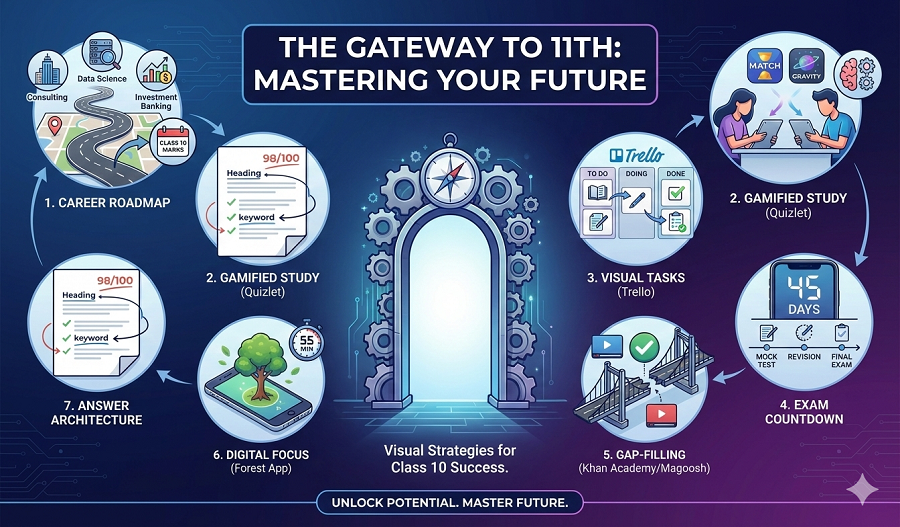
The Gateway to 11th: How Class 10th Marks Shape Your Future Streams
Your Class 10th marks are the first filter for elite careers in Management Consulting, Data Science, and Investment Banking. This guide shows you how to master every subject using smart tools: gamify learning with Quizlet, organize your syllabus with Trello, stay focused with Forest app, and learn topper answer-writing techniques. Transform your study routine and secure your dream stream with these battle-tested strategies.
⇒ What You'll Learn:
- Career impact of 10th marks
- 6 game-changing study tools
- Topper answer techniques
- Complete action plan
⏱️ Read Time: 12 minutes
The Professional Filter: Your Career Roadmap Starts Here
Let's be honest: most students see Class 10th as just another exam. But here's what they don't tell you in assembly—your 10th marks act as the first major filter for some of the most prestigious and high-paying career paths in the world.
Think about it: When top companies recruit for positions in Management Consulting (BCG, McKinsey), Data Science (Google, Microsoft), or Investment Banking (Goldman Sachs, JP Morgan), they don't just look at your college degree. They trace your academic journey all the way back to Class 10th. A strong foundation signals consistency, discipline, and intellectual capability—qualities these elite firms actively seek.
Here's how the filter works in practice:
Firms evaluate your analytical thinking and problem-solving ability from an early age. Strong 10th marks demonstrate foundational logic and mathematical reasoning—prerequisites for case interviews and client work.
Your mathematics and science scores in 10th reveal your aptitude for statistics, algorithms, and computational thinking. Top tech companies use these as early indicators of technical capability.
Banking recruiters look for consistent academic excellence. Your 10th marks prove you can handle pressure, master complex concepts, and maintain high standards—essential traits for 80-hour work weeks and multi-million dollar deals.
Beyond career gatekeeping, your Class 10th marks determine which stream you can pursue in 11th. Want Science with PCM (Physics, Chemistry, Math) to become an engineer? Most competitive schools require 85%+ in 10th. Eyeing Commerce with specific electives for CA or Finance? You'll need strong math and English scores. Even Arts streams at prestigious institutions have cutoffs.
The bottom line: Class 10th isn't just about getting into 11th—it's about keeping every door open for the next decade of your academic and professional life.

Question Bank : Click Here
Strategy 1: Gamified Mastery with Quizlet
Let's face it—memorizing dates for History or formulas for Math can feel mind-numbingly boring. But what if studying felt more like playing a game than doing homework?
Quizlet transforms your study sessions into interactive challenges. Instead of passively reading notes, you're actively engaging with content through gamified modes designed to make learning stick.
How to Use Quizlet for Class 10th:
1. Match Mode: Race against the clock to pair terms with definitions. Perfect for subjects like Science (matching elements with properties), Social Studies (matching events with dates), or languages (vocabulary building). The timer adds urgency and makes repetition feel competitive rather than tedious.
2. Gravity Mode: Defend your planet from falling asteroids labeled with questions by typing the correct answers before they crash. This arcade-style game is brilliant for rapid recall—ideal for formula memorization in Math or chemical equations in Science.
3. Learn Mode (The Secret Weapon): This is where Quizlet gets smart. The "Learn" mode adapts to your performance, focusing more on concepts you struggle with and less on what you've already mastered. It creates custom study paths based on your strengths and weaknesses, ensuring you spend time where it matters most.
Pro Tip: Create flashcard sets for each chapter immediately after covering it in class. Then use Match mode for quick daily reviews (5-10 minutes) and Gravity mode before tests for intense practice. The Learn mode becomes your exam revision tool in the final weeks.
The psychology behind gamification is simple: your brain releases dopamine when you win, complete challenges, or beat your previous scores. By associating studying with these positive feelings, you're literally rewiring your brain to enjoy learning. For Class 10th students juggling multiple subjects, this approach prevents burnout and makes daily revision something to look forward to rather than dread.
Strategy 2: Visual Task Management via Trello
Class 10th isn't a sprint—it's a marathon. With 5-6 subjects, multiple chapters per subject, and internal assessments throughout the year, keeping track of everything in your head (or worse, on random pieces of paper) is a recipe for disaster.
Trello is a project management tool that helps you break down the massive Class 10th syllabus into bite-sized, manageable chunks. Think of it as a digital whiteboard with sticky notes you can move around—except infinitely more powerful.
Setting Up Your Class 10th Trello Board:
Step 1: Create Subject-Based Lists
Set up vertical columns (lists) for each subject: Math, Science, Social Studies, English, and your optional language. This gives you a bird's-eye view of all your academic responsibilities.
Step 2: Break Chapters into Cards
Within each subject list, create individual cards for every chapter. For example, in Science, you might have cards for "Chemical Reactions," "Electricity," "Heredity and Evolution," etc. Each card becomes a mini-project.
Step 3: Add Checklists to Cards
Here's where the magic happens. Click into a chapter card and create a checklist with specific tasks:
- Complete NCERT exercises 1-10
- Make Quizlet flashcards for key terms
- Solve 5 previous year questions
- Review and summarize main formulas/concepts
Step 4: Use Labels for Priority and Status
Assign color-coded labels to cards:
- ? Red: High priority / exam next week
- ? Yellow: Medium priority / needs review soon
- ? Green: Completed and mastered
- ? Blue: Extra challenge problems for toppers
Advanced Strategy: Create a separate "Weekly Goals" list where you drag 3-5 chapter cards each week. This creates a focused mini-syllabus that prevents overwhelm. At the end of the week, completed cards move to a "Mastered" list—giving you a visual record of progress that builds confidence.
The beauty of Trello is that it externalizes your mental load. Instead of trying to remember what you need to study, when assignments are due, or which chapters you've covered, everything lives in one organized space. This reduces stress dramatically and ensures nothing falls through the cracks during the busy Class 10th year.
Strategy 3: Deadline Visualization with Exam Countdown
There's a dangerous psychological trap students fall into during Class 10th: the "board exams feel far away" syndrome. In April, February seems distant. By December, you tell yourself there's still plenty of time. Then suddenly it's January, and panic sets in.
The Exam Countdown app does one thing brilliantly: it makes abstract future deadlines feel real and immediate. By providing a clear visual timeline of your exam dates and study milestones, it creates healthy urgency without inducing panic.
How to Use Exam Countdown Effectively:
Set Up Multiple Countdowns: Don't just set one countdown for "Board Exams." Create separate countdowns for:
- Each unit test (monthly or quarterly)
- Pre-board exams (usually in January)
- Individual board exam dates (Math, Science, Social Studies, etc.)
- Internal assessment deadlines (projects, practicals)
Set Study Milestone Countdowns: Here's a clever technique—set countdowns for study goals, not just exams. For example:
- "Complete Math syllabus - 60 days left"
- "Finish Science revision - 45 days left"
- "Master Social Studies maps - 30 days left"
The Daily Glance Habit: Make it a ritual to check your countdowns every morning when you wake up and every night before bed. Seeing "87 days until Math board exam" creates a subtle mental pressure that keeps you focused on the present rather than procrastinating because "there's still time." The countdown becomes your accountability partner.
Cognitive psychologists call this "temporal discounting"—our tendency to value immediate rewards over future ones. Exam Countdown fights this by making the future feel present. When you see the days ticking away in real-time, cramming becomes less tempting, and consistent daily effort becomes more appealing. It's a simple tool with profound psychological impact.
Strategy 4: Foundational Gap-Filling
Here's an uncomfortable truth: if you're aiming for competitive streams like Science with PCM or Commerce with high-level Math, you cannot afford to have knowledge gaps from previous classes. A shaky foundation in 9th-grade algebra will haunt you in 10th trigonometry, which will cripple you in 11th calculus.
The good news? You can fill these gaps systematically before they become bigger problems.
Don't let pride stop you from going back to basics. The students who score 95%+ in Class 10th aren't necessarily smarter—they're just more willing to admit when they don't understand something and systematically fix it. These tools make that process painless and, frankly, kind of fun.
Strategy 5: The Digital Focus Habit
Be honest with yourself: how many times have you sat down to study, only to "quickly check" Instagram... and emerge 45 minutes later having accomplished nothing? You're not weak-willed—you're just human. Social media apps are literally designed by teams of psychologists to be addictive.
The solution isn't willpower (which depletes). It's creating a system that makes focus the path of least resistance.
Forest is a beautifully simple app built on one insight: humans love watching things grow, and we hate killing things we've nurtured. Here's how it works: when you want to focus, you plant a virtual tree. That tree grows while you stay off your phone. If you exit the app to check social media, the tree dies.
Why Forest Works for Class 10th Students:
Visual Progress Tracking: Over time, you build an entire forest—a visual record of every focused study session you've completed. Looking at your thriving forest after a month of consistent studying is incredibly motivating. It's proof of your discipline made tangible.
Social Accountability: Forest has a "team mode" where you and your friends plant a tree together. If anyone breaks focus and kills the tree, everyone loses. This peer pressure (the good kind) keeps you accountable. Start a "Class 10th Study Squad" with classmates who are equally serious about their marks.
Real-World Impact: The premium version partners with tree-planting organizations. Your virtual trees translate into real trees planted around the world. You're literally fighting climate change while studying for Math—talk about motivation.
Smart Phone Blocking: Forest integrates with your phone's app permissions to actually block distracting apps during focus sessions. This removes the temptation entirely. You can whitelist essential apps (like calculator or dictionary) while blocking social media, games, and YouTube.
The 25-Minute Forest Technique: Plant a tree for each 25-minute focused study session, then take a 5-minute break (your tree is fully grown). Do four of these cycles, then take a longer 15-20 minute break. This rhythm—focused bursts with short breaks—matches your brain's natural attention span and prevents mental fatigue. By the end of a day, you'll have a small forest representing 2-3 hours of deep, distraction-free studying.
What makes Forest special is that it doesn't rely on guilt or shame to keep you focused. Instead, it taps into your desire to build something, to see progress, to not let down your teammates. It transforms focus from an act of deprivation ("I can't use my phone") to an act of creation ("I'm building my forest"). That psychological reframe is powerful.
 Sample Paper : Click Here
Strategy 6: Answer Architecture for 95%+
Here's a secret that most Class 10th students never learn: you can understand every concept perfectly and still score poorly if you don't know how to write answers the way examiners expect.
Board exams aren't just testing your knowledge—they're testing your ability to communicate that knowledge in a specific format. And the fastest way to learn that format? Study how the toppers do it.
Many schools and educational websites publish anonymized answer sheets from students who scored 95%+. These aren't just "correct" answers—they're masterclasses in exam technique.
What to Look For in Topper Answer Sheets:
1. Step-Wise Logic (Especially in Math and Science): Notice how toppers never skip steps, even when the intermediate calculation seems obvious. They write:
- Given: [restate the problem]
- To find: [identify what's being asked]
- Formula: [write the relevant equation]
- Substitution: [plug in values]
- Calculation: [show working]
- Answer: [state final result with units]
2. Clear Headings and Sub-Headings: In Social Studies and English answers, toppers use:
- Underlined headings for each main point
- Bullet points or numbered lists for sub-points
- Short, focused paragraphs (3-4 lines maximum)
3. Key Term Underlining: Toppers underline or highlight important keywords and technical terms. For example, in a question about "factors affecting photosynthesis," they'd underline chlorophyll, stomata, carbon dioxide, light intensity, etc. This shows the examiner you know the precise vocabulary and aren't just writing general fluff.
4. Diagram Labels: In Science, neat diagrams with all parts correctly labeled often carry 2-3 marks. Toppers use rulers for straight lines, label every component clearly, and add a brief explanatory note about the diagram's significance. Never leave a diagram unlabeled or messy.
5. Introduction and Conclusion: For longer answers (5-10 marks), toppers include a one-sentence introduction that directly addresses the question, then conclude with a summary sentence. This "sandwich structure" signals to the examiner that you've given a complete, well-organized response.
Practice Technique: Find topper answer sheets for topics you've studied. Read their answer, then try to recreate it from memory without looking. Compare your version to theirs. What did you miss? What could be clearer? Then practice writing 2-3 answers in their style. This deliberate imitation trains you to automatically structure answers in exam-friendly ways. After a few weeks of practice, it becomes second nature.
Remember: board exam marking is semi-subjective. The examiner has a marking scheme with allocated points for specific elements (definitions, diagrams, examples, etc.). By studying topper answer sheets, you reverse-engineer this marking scheme and learn exactly what examiners are looking for. It's like getting the answer key before the test—not to cheat, but to understand the game you're playing.

.png)